Flying with your pickleball bag: rules and dimensions
Published on October 21, 2026 Reviewed October 22, 2026 About 6 min
The Bagage de Court editorial team.
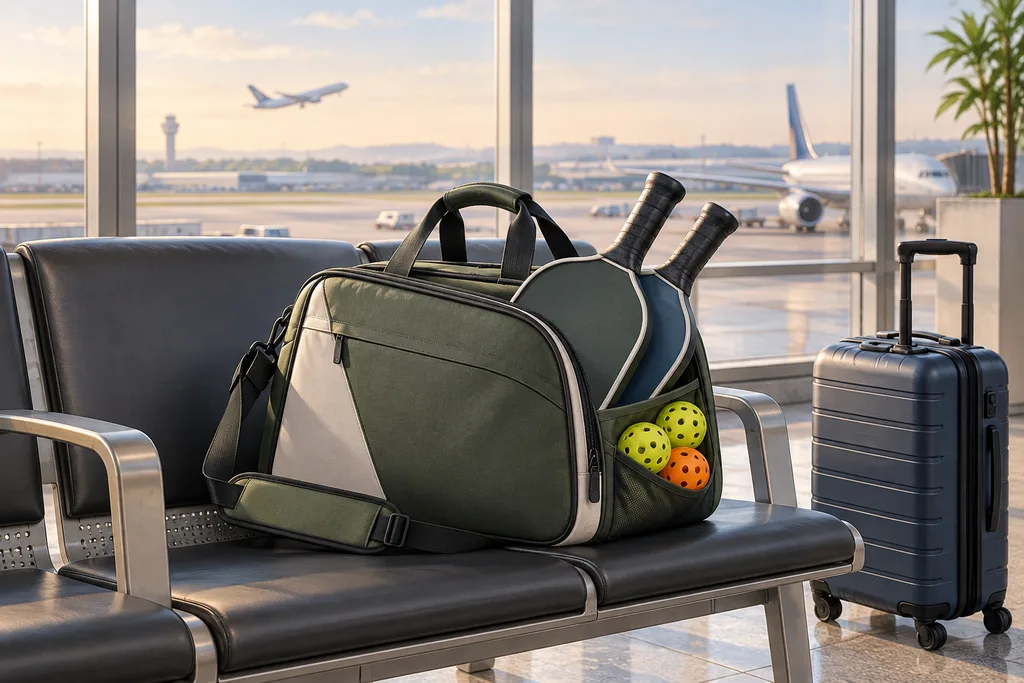
Flying with your paddles means following each airline's rules and the security instructions. This section sums up what has been published and what is still under discussion. Welcome to "Traveling by plane with your gear," where everything is arranged in order of usefulness.
The fundamentals
A regulatory point: drinks are explicitly among the products subject to the 100 ml cabin rule; medication and baby food are exempt.
On the rules side: items that can cause injury, such as walking sticks and skateboards, are banned in the cabin. Weapons are too, including toy or imitation weapons.
On the rules side: on January 21, 2026, the European Parliament adopted its position, with 632 votes for, 15 against, and 9 abstentions, in favor of two free carry-on bags.
To stay compliant, the agreement provides for a personal item of 40×30×15 cm and a cabin bag of 100 cm maximum combined dimensions and 7 kg maximum; the traveler may give up the larger bag in exchange for a reduced fare.
A core rule to remember: bags are X-rayed or inspected before you enter the security zone.
Your starting point
Work through the procedure below without skipping a line.
- If your bag is damaged or lost, you need to fill out a baggage irregularity report at the airport right away, with the airline's baggage claims desk. Without this document, the passenger will have a hard time proving that the damage happened during the flight.
- Cabin bag dimensions and the number of bags allowed are set by each airline: check them with the carrier before departure.
- The written claim must include a letter describing and valuing the damage, along with supporting documents (invoices, receipts). For expensive sports gear, it is best to keep your proof of purchase.
- Duty-free purchases must stay in the sealed security bag provided, with the receipt, until your final destination.
- To find a battery's capacity in Wh, multiply its voltage in volts by its capacity in amp-hours. If the capacity is given in mAh, convert it: voltage × mAh ÷ 1,000.
Additional benchmarks, no detours
On the data side, note this: for lithium batteries up to 100 Wh, a reasonable quantity is allowed if each battery is individually protected against short circuits. From 100 to 160 Wh, a maximum of two loose batteries are allowed, with the airline's prior approval. Above 160 Wh, carriage is prohibited.
On the data side, note this: weight limits for the personal item vary by airline, from no limit at all to 10 kg (as of February 2026).
Here is the value to know: airlines for Europe (A4E) set 40×30×15 cm as the guaranteed minimum for a free personal item; 17 member airlines, representing more than 80% of European traffic, have committed to it.
Pitfalls to know about
Here are the mistakes that are easiest to make.
- Passengers departing from the United Kingdom will not benefit from the new European rules, except on return flights from the EU, according to easyJet UK as cited by Euronews.
- The 2015 IATA recommendation is only a guideline — IATA paused the rollout in June 2015, and major airlines keep their own allowances.
- For a flight with only a personal item, check the airline's exact dimensions before departure: they range from 40×30×15 cm to 45×36×20 cm depending on the carrier.
- Failing to follow the list of items banned in the cabin exposes you to confiscation of the item and to penalties. The official fact sheet mentions an administrative fine of up to €10,000.
Going a little further
Here is a way to get your bearings, point by point.
- Airlines will be able to keep offering reduced fares to passengers traveling without a cabin bag; the pricing model is not yet defined.
- The Montreal Convention applies to European Union carriers on all of their routes. It caps liability at 1,519 special drawing rights (SDR) per passenger. This cap is not an automatic payout: the passenger must prove the actual loss.
- A Parliament vote does not create law on its own — the text still had to be approved by the Council of the European Union, which represents the 27 member states.
- In February 2026, the free personal item measured 45×36×20 cm at easyJet, 40×30×20 cm at Ryanair, Wizz Air, Vueling, and Volotea, 40×30×25 cm at Eurowings, and 40×30×15 cm at Air France.
- In the cabin, one person may carry a maximum of two power banks. Each must be insulated against short circuits, and recharging them on board the aircraft is prohibited.
- At check-in, you can declare a value of special interest to raise the compensation cap. The airline may charge a supplement for this. It is an option to consider for a bag containing valuable gear.
- The Council of the EU and the European Parliament reached an agreement in June 2026 on air passenger rights, after more than ten years of negotiations.
Related articles
- Pickleball gear: what the FFT says and what to pack in your bag — FFT rules and the basic gear to carry. On this page: the guiding ideas, the full article library, and your best starting point.
- Backpack or multi-paddle bag: which format for pickleball? — Compare bag formats based on how often you play and the gear you carry, so you can choose with confidence. Pointers to help you decide between the options.
- Pickleball bag: the most common buying mistakes — Spot the classic traps before buying a bag: size, carrying comfort, and keeping your things separate. A commented walkthrough from start to finish.
- What the federation says about the paddle, ball, and court in pickleball — Find out in the federation rules what you need to bring to play. In this article: how it works in practice and the step-by-step walkthrough.
References
- Restrictions applicables aux bagages — Cabin liquids rule (100 ml, one-liter transparent bag) and clarification that airlines set their own baggage limits. Source verified on 2026-10-13.
- Vol en avion : quels sont les objets interdits en cabine ? — Official fact sheet on items and liquids banned in the cabin. Source verified on 2026-10-15.
- Bagages cabine gratuits sur Ryanair et easyJet : l'Europe a voté, mais vous n'êtes pas tirés d'affaires — State of European regulation in April 2026: text not yet adopted by the Council, no actual change. Source verified on 2026-10-13.
- Bagages cabine gratuits et maintien des indemnisations de retard : dix ans de négociations —
- Que faire en cas de perte ou de détérioration de bagages — Rights and steps to take for lost, delayed, or damaged baggage. Source verified on 2026-10-15.
- Appareils électroniques (piles au lithium et batteries externes) — Rules for carrying lithium batteries and power banks. Source verified on 2026-10-15.
- Explications : comment vont fonctionner les nouvelles règles UE sur les bagages cabine —
- IATA develops new carry-on bag size guideline but complete consistency unlikely to emerge — IATA optimal dimension of 55 x 35 x 20 cm, non-binding, and suspension of the Cabin OK initiative in 2015. Source verified on 2026-10-13.
- Le guide 2026 des bagages cabine gratuits en Europe — Commitment by Airlines for Europe carriers to a personal item of at least 40 x 30 x 15 cm. Source verified on 2026-10-13.
Baggage dimensions and conditions vary by airline and change over time: always check your carrier's rules before departure.
European law on free cabin baggage is under discussion and does not apply yet: the information on this site is dated.