Pickleball gear: what the FFT says and what to pack in your bag
Published on October 21, 2026 Reviewed October 22, 2026 About 6 min
The Bagage de Court editorial team.
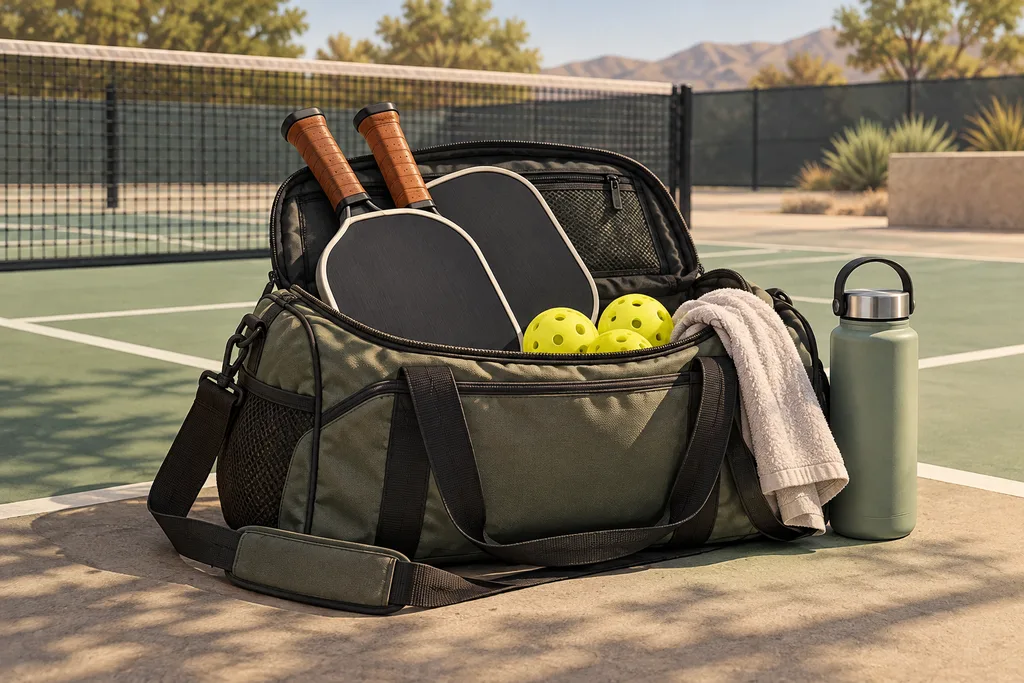
Knowing what gear to bring starts with knowing the rules of the game and the basic equipment. This section draws on the texts of the Fédération française de tennis. Head into "Rules and playing equipment": landmarks, key terms, and articles are waiting for you.
The guiding ideas
Keep this logic in mind: a live ball that touches a court line is good. A ball that lands entirely outside the court on the ground is a fault.
Here is the guiding idea: the USA Pickleball rulebook allows two types of serve, the volley serve and the "drop serve," where the ball is hit after it has bounced. The drop serve has no limit on the number or location of bounces. Take a moment to make sure you understand it.
A core rule to remember is the double-bounce rule: after the serve, the ball must bounce once on each side before volleys are allowed.
The principle comes down to this: in doubles, the score is called with three numbers, the serving team's score, the receiving team's score, and then the server number (one or two). The entire score must be called before the serve.
At the heart of the matter, in doubles, both partners serve before the serve passes to the opponents, except for the very first serve.
The article library
Here are the reads offered in this section.
- Backpack or multi-paddle bag: which format for playing pickleball? — compare bag formats based on how often you play and the gear you carry, so you can choose without mistakes.
- Starting pickleball: what to put in your first bag? — put together a complete first pickleball bag without buying useless accessories.
- Bag capacity: calculating its volume in liters from its dimensions — estimate a bag's volume in a few seconds from its three dimensions and compare it with your needs.
- Pickleball bag: the most common buying mistakes — spot the classic traps before buying a bag: size, carrying comfort, separating your things.
- Pickleball paddle cover: what is it really for? — find out whether a cover is useful for your play and what types of protection exist.
- Organizing your bag pockets: a checklist before you head out to play — get your bag ready in a few minutes with a simple list to tick off before every session.
- Pickleball and badminton: what the federations coming closer means for clubs — understand the federal context of pickleball in France and its effect on access to courts and to play.
Your starting point
Take the actions in order, as they complement each other.
- To distribute the load in a bag well, keep its center of gravity close to your body: heavy items against your back, light items on the outside, and avoid heavy loads on your lower back or at the top.
- If you are unsure about a line call, a ball that cannot be called "out" is considered good.
What should guide your choice
Ask yourself these questions, one after the other, before you decide.
- The hitting surface of a regulation paddle must show no delamination, no holes, no cracks, no rough texture, and no dents that break the skin of the paddle (USA Pickleball rulebook).
- A well-designed bag has two wide, padded, adjustable shoulder straps, tightened to keep the bag close to the body, and a waist belt can help distribute the weight.
- On the serve, at least one foot must stay on the ground behind the baseline, and neither foot may touch the court on the baseline or inside it.
- The USA Pickleball rulebook requires a ball made of a durable material, molded with a smooth, untextured surface and a single uniform color, apart from identification markings.
Background information
A measured benchmark: the pickleball net is 6.70 m wide, with a height of 86 cm at the center and 91 cm at the posts.
On the data side, note this: according to the USA Pickleball rulebook, the sum of the paddle's length and width, edges and end cap included, must not exceed 24 inches (60.96 cm), and its length cannot exceed 17 inches (43.18 cm).
A figure to keep handy: according to the FFT, a pickleball paddle weighs about 240 grams and measures about 40 cm tall by 20 cm wide; it is made of composite or fiberglass.
Pitfalls to know about
Keep an eye on these stumbling blocks before you get started.
- A serve that touches the net and then lands in the opponent's non-volley zone or outside the service zone is a fault.
- If a non-compliant paddle is detected before the match begins, the player may change it without penalty; once the match has started, the team forfeits that match; after the score sheet has been handed in, the result stands.
- These are faults — touching the net, the posts, or the opponent's court with the player, clothing, or paddle while the ball is in play, or stopping a ball in play before it is dead.
- Signs of an overly heavy bag cited by the American Academy of Pediatrics: leaning forward to compensate, struggling to walk, straps digging into the shoulders.
- After touching the non-volley zone, a player may volley only after putting both feet back on the ground entirely outside the zone. Jumping from the zone to volley and then landing outside is a fault.
Also worth exploring
The following list brings together the useful notions.
- According to the FFT, the recommended surfaces for a pickleball court are resin and porous concrete.
- In tournaments, a player may be asked to change outfits if theirs is inappropriate, notably if the clothing is a color close to that of the tournament ball.
- A pickleball match is generally played as one set of 11 points, or one set of 15 points with a 2-point margin, according to the FFT.
- The serve is made underhand, diagonally toward the opponent's service zone, from behind the baseline.
- The pickleball is a hard plastic ball, slightly larger than a tennis ball, with holes (26 to 40 according to the FFT); indoor and outdoor models differ in the number and size of the holes.
On the gear side, to try out a few pickleballs, you can go through Rally.
Related articles
- Pickleball bag: the most common buying mistakes — Spot the classic traps before buying a bag: size, carrying comfort, and keeping your things separate. A commented walkthrough from start to finish.
- Pickleball and badminton: what the federations coming closer together changes for clubs — Understand the federal context of pickleball in France and its effect on access to gyms and play. In this article: what we observe.
- What the federation says about the paddle, ball, and court in pickleball — Find out in the federation rules what you need to bring to play. In this article: how it works in practice and the step-by-step walkthrough.
- Backpack or multi-paddle bag: which format for pickleball? — Compare bag formats based on how often you play and the gear you carry, so you can choose with confidence. Pointers to help you decide between the options.
References
- 2025 USA Pickleball Rules – Section 6: Line Call Rules — Official rulebook: ball in or out, responsibility for calls. Source verified on 2026-10-13.
- 2025 USA Pickleball Rules – Section 4: The Serve, Service Sequence, and Scoring — Official rulebook: serve, service sequence, score calling. Source verified on 2026-10-13.
- Les règles du pickleball — Rules of the game, court and net dimensions, general description of the paddle and ball. Source verified on 2026-10-13.
- Préparer son sac à dos — Federation advice on maximum load and weight distribution in a backpack. Source verified on 2026-10-15.
- 2025 USA Pickleball Rules – Section 2: Court and Equipment — Official rulebook of the American federation: paddle dimensions, ball, lines, net. Source verified on 2026-10-13.
- 2025 USA Pickleball Rules – Section 7: Fault Rules — Official rulebook: list of faults. Source verified on 2026-10-13.
- Des cartables lourds peuvent fatiguer les enfants : comment alléger la charge — Signs of an overly heavy bag and features of a well-designed bag (straps, belt). Source verified on 2026-10-15.
- 2025 USA Pickleball Rules – Section 9: Non-Volley Zone Rules — Official rulebook: non-volley zone. Source verified on 2026-10-13.
Baggage dimensions and conditions vary by airline and change over time: always check your carrier's rules before departure.
European law on free cabin baggage is under discussion and does not apply yet: the information on this site is dated.