Pickleball paddle cover: what is it really for?
Published on October 21, 2026 Reviewed October 22, 2026 About 4 min
The Bagage de Court editorial team.
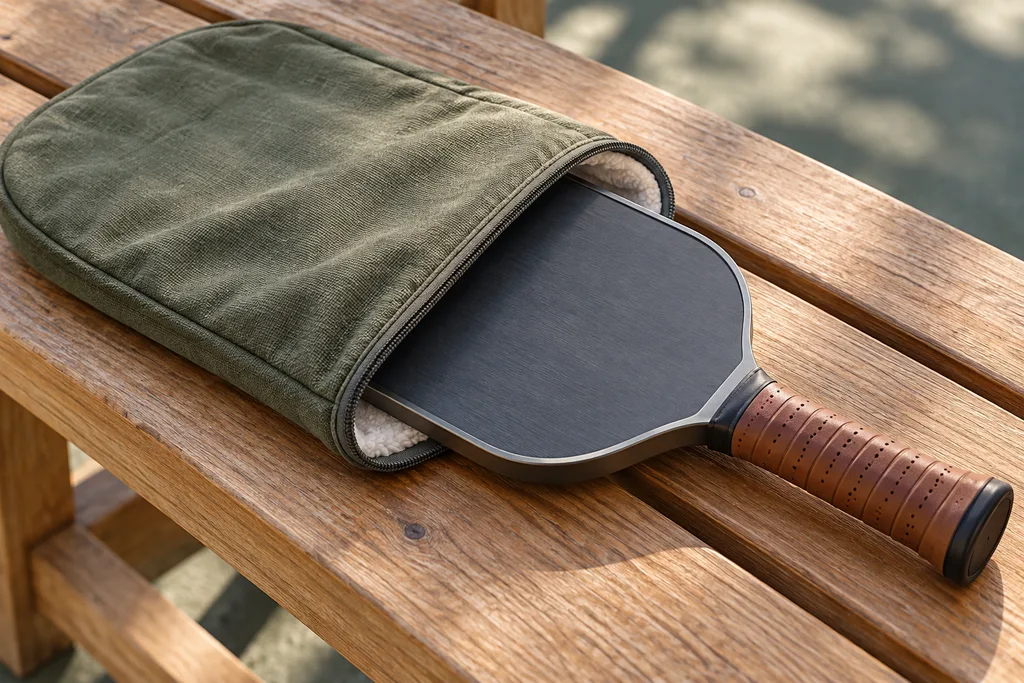
You opened "Pickleball paddle cover: what is it really for?" so let us get straight to what matters. Find out whether a cover is useful for your play and what types of protection exist. Each part has its role, in this order: how it all fits together, your sorting criteria, and what not to overlook. Who it is for: pickleball players in France, beginners or club members, who want to choose and organize their bag and travel with their gear.
How it all fits together
Basic rule to remember: the serve is made underhand, diagonally toward the opponent's service area, from behind the baseline.
Keep this in mind: the rule of 10 to 15% of body weight for a school bag is often cited, but a doctor who was interviewed believes there is not enough evidence to make it a valid recommendation for everyone. Make a note of it, since everything else follows from it.
Rule point: in a match with line judges, the only line call left to the players is the centerline on the serve.
At the heart of the matter, the double bounce rule: after the serve, the ball must bounce once on each side before volleying is allowed.
Your sorting criteria
Ask yourself these questions, one after the other, before you decide.
- The USA Pickleball rulebook allows two types of serve — the volley serve, and the "drop serve," where the ball is hit after it has bounced. The drop serve places no limit on the number or location of bounces.
- According to the FFT, the recommended surfaces for a pickleball court are resin and porous concrete.
- The court has the same dimensions, 6.10 m by 13.41 m, in singles and in doubles, according to USA Pickleball.
- In doubles, the score is called with three numbers — the serving team's score, the receiving team's score, then the server number (one or two). The entire score must be called before the serve.
- The hitting surface of a legal paddle must show no delamination, hole, crack, rough texture, or dent that breaks the skin of the paddle (USA Pickleball rulebook).
To put it into practice, la gamme Rally offers, among others, "Raquette Rally — Carbone T700," to give you an idea.
What not to overlook
Here is what trips people up most often.
- The non-volley zone fault also applies to momentum — if the volleyer's momentum makes them touch the zone, or touch their partner who is touching it, it is a fault, even if the ball is already dead.
- After the serve, a ball that hits a player or anything the player is wearing is a fault, except for the paddle or the hand below the wrist holding the paddle.
- After touching the non-volley zone, a player may volley only after getting both feet back on the ground completely outside the zone. Jumping from the zone to volley and then landing outside is a fault.
- These are faults — touching the net, the posts, or the opponent's court with the player, clothing, or paddle while the ball is in play, or stopping a ball in play before it is dead.
- If a noncompliant paddle is detected before the match starts, the player may change it without penalty; once the match has started, the team loses that match; after the score sheet has been turned in, the result stands.
Key points at a glance
These few points are the basics to know.
- A well-designed bag has two wide, padded, adjustable straps, tightened to keep the bag close to the body, and a hip belt can help spread the weight.
- The USA Pickleball rulebook sets no weight limit for the paddle.
Your cheat sheet
If you remember only this, it will already be useful.
- In doubles, the score is called with three numbers.
- The non-volley zone fault also applies to momentum.
- The USA Pickleball rulebook allows two types of serve.
Before you go
Take the time to browse the related pages to round out your reading.
Related articles
- Getting started in pickleball: what goes in your first bag? — Build a complete first pickleball bag without buying useless accessories. On this page: how everything fits together and how to start gently.
- Bag capacity: how to calculate its volume in liters from its dimensions — Estimate a bag's volume in seconds from its three dimensions and compare it with your needs. Instructions laid out step by step.
- Pickleball gear: what the FFT says and what to pack in your bag — FFT rules and the basic gear to carry. On this page: the guiding ideas, the full article library, and your best starting point.
- Backpack or multi-paddle bag: which format for pickleball? — Compare bag formats based on how often you play and the gear you carry, so you can choose with confidence. Pointers to help you decide between the options.
References
- Les règles du pickleball — Rules of the game, court and net dimensions, general description of the paddle and ball. Page read on 2026-10-13.
- Des cartables lourds peuvent fatiguer les enfants : comment alléger la charge — Signs of a bag that is too heavy and features of a well-designed bag (straps, belt). Page read on 2026-10-15.
- 2025 USA Pickleball Rules – Section 6: Line Call Rules — Official rulebook: ball in or out, responsibility for calls. Page read on 2026-10-13.
- 2025 USA Pickleball Rules – Section 4: The Serve, Service Sequence, and Scoring — Official rulebook: serve, service sequence, score calling. Page read on 2026-10-13.
- 2025 USA Pickleball Rules – Section 2: Court and Equipment — Official rulebook of the American federation: paddle dimensions, ball, lines, net. Page read on 2026-10-13.
- 2025 USA Pickleball Rules – Section 9: Non-Volley Zone Rules — Official rulebook: non-volley zone. Page read on 2026-10-13.
- 2025 USA Pickleball Rules – Section 7: Fault Rules — Official rulebook: list of faults. Page read on 2026-10-13.
Baggage dimensions and conditions vary by airline and change over time: always check your carrier's rules before you leave.
European law on free cabin baggage is under discussion and does not apply yet: the information on this site is dated.