Pickleball: the vocabulary of the game for beginners (serve, non-volley zone)
Published on October 21, 2026 Reviewed October 21, 2026 About 4 min
The Bagage de Court editorial team.
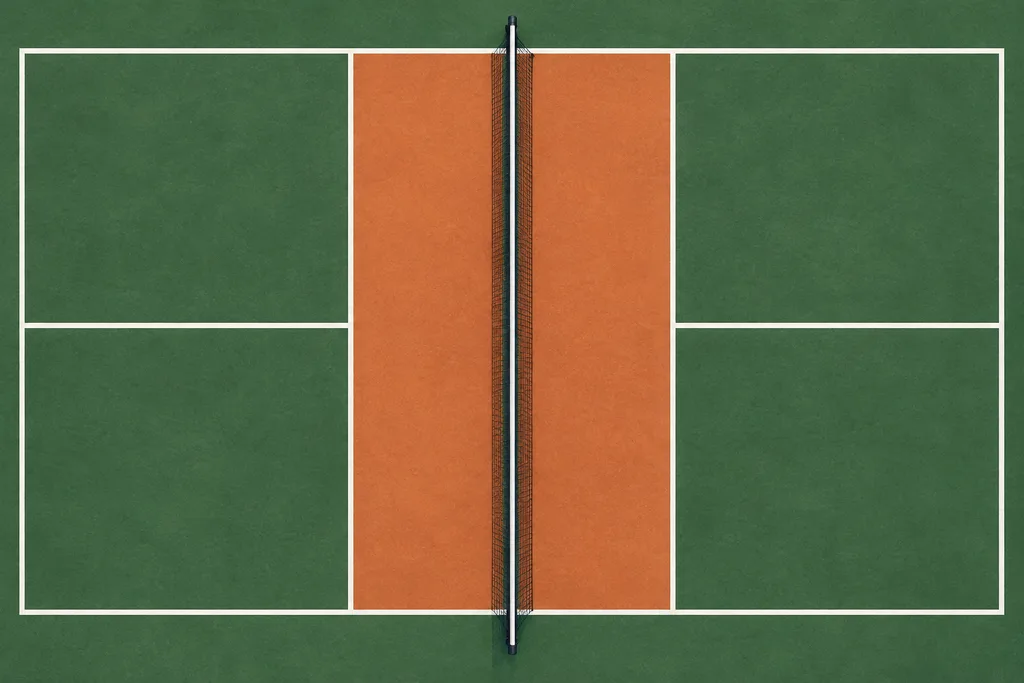
Under the title "Pickleball: the vocabulary of the game for beginners (serve, non-volley zone)," this article lays out the basics in a simple reading order. Understand the basic pickleball terms to follow a first game and read the rules. The sections, in order: how it works, the first steps, and the pitfalls to avoid. Who it is for: pickleball players in France, beginners or club members, who want to choose and organize their bag and travel with their gear.
How it works
Starting point, the double bounce rule: after the serve, the ball must bounce once on each side before volleying is allowed.
A basic point: the USA Pickleball rulebook sets no weight limit for the paddle.
One principle to know: in doubles, the score is called with three numbers: the serving team's score, the receiving team's score, then the server number (one or two). The entire score must be called before the serve. Check it against your own situation.
One principle to know: in doubles, both partners serve before the serve passes to the opponents, except for the very first serve.
The first steps
The steps, in the order in which they come up:
- If you are unsure about a line call, a ball that cannot be called "out" is considered good.
- To spread the load in a bag well, keep its center of gravity close to your body: heavy items against your back, light items on the outside, and no heavy loads on the lower back or at the top.
Pitfalls to avoid
Keep these in mind before you get started:
- If a noncompliant paddle is detected before the match starts, the player may change it without penalty; once the match has started, the team loses that match; after the score sheet has been turned in, the result stands.
- These are faults — touching the net, the posts, or the opponent's court with the player, clothing, or paddle while the ball is in play, or stopping a ball in play before it is dead.
- Signs of a bag that is too heavy, cited by the American Academy of Pediatrics: leaning forward to compensate, walking with difficulty, straps digging into the shoulders.
- After touching the non-volley zone, a player may volley only after getting both feet back on the ground completely outside the zone. Jumping from the zone to volley and then landing outside is a fault.
- A serve that hits the net and then lands in the opponent's non-volley zone or outside the service area is a fault.
What is the non-volley zone?
By the numbers: each team has two timeouts for games to 11 or 15 points, and three for a game to 21 points. Each lasts one minute at most.
By the numbers: a pickleball court measures 6.10 m wide by 13.41 m long, according to the Fédération française de tennis.
By the numbers: all the lines on a pickleball court are 2 inches (5.08 cm) wide, according to the USA Pickleball rulebook.
How does the serve work?
By the numbers: the USA Pickleball rulebook calls for a gap of 22 feet (± 1 inch, or 6.71 m) between the net posts, and a net at least 21 feet 9 inches (6.63 m) long.
By the numbers: USA Pickleball specifies a minimum playing area of 30 feet wide by 60 feet long, which is more than the court itself (20 by 44 feet), to leave room around the lines.
Final word
This article covered how it works, the first steps, and the pitfalls to avoid. Go back over the points above in the order that fits your situation.
Related articles
- Pickleball gear: what the FFT says and what to pack in your bag — FFT rules and the basic gear to carry. On this page: the guiding ideas, the full article library, and your best starting point.
- Pickleball and badminton: what the federations coming closer together changes for clubs — Understand the federal context of pickleball in France and its effect on access to gyms and play. In this article: what we observe.
- What the federation says about the paddle, ball, and court in pickleball — Find out in the federation rules what you need to bring to play. In this article: how it works in practice and the step-by-step walkthrough.
- Pickleball paddle cover: what is it really for? — Find out whether a cover is useful for your play and what types of protection exist. Covered here: how it all fits together and your sorting criteria.
References
- Les règles du pickleball — Rules of the game, court and net dimensions, general description of the paddle and ball. Accessed 2026-10-13.
- 2025 USA Pickleball Rules – Section 2: Court and Equipment — Official rulebook of the American federation: paddle dimensions, ball, lines, net. Accessed 2026-10-13.
- 2025 USA Pickleball Rules – Section 4: The Serve, Service Sequence, and Scoring — Official rulebook: serve, service sequence, score calling. Accessed 2026-10-13.
- 2025 USA Pickleball Rules – Section 6: Line Call Rules — Official rulebook: ball in or out, responsibility for calls. Accessed 2026-10-13.
- Préparer son sac à dos — Federation advice on maximum load and weight distribution in a backpack. Accessed 2026-10-15.
- 2025 USA Pickleball Rules – Section 7: Fault Rules — Official rulebook: list of faults. Accessed 2026-10-13.
- Des cartables lourds peuvent fatiguer les enfants : comment alléger la charge — Signs of a bag that is too heavy and features of a well-designed bag (straps, belt). Accessed 2026-10-15.
- 2025 USA Pickleball Rules – Section 9: Non-Volley Zone Rules — Official rulebook: non-volley zone. Accessed 2026-10-13.
- 2025 USA Pickleball Rules – Section 10: Time-Out Rules — Official rulebook: timeouts. Accessed 2026-10-13.
Baggage dimensions and conditions vary by airline and change over time: always check your carrier's rules before you leave.
European law on free cabin baggage is under discussion and does not apply yet: the information on this site is dated.